![VannDigital.com (2022) [Light Banner-Viral Pro]](https://www.vanndigital.com/wp-content/uploads/vanndigitalcom-2022-light-banner-viral-pro.png)
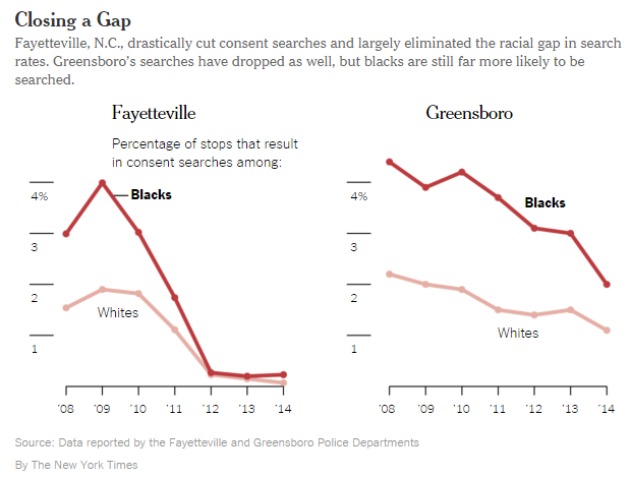
Two states–Rhode Island and Connecticut—have changed their practices in light of the racial disparities. Rhode Island overhauled its training and conducted fewer vehicle searches, while finding contraband more often. Further, Connecticut requires its officers to give every stopped driver a card explaining how to file a police complaint.
Meanwhile, California recently passed a law requiring police officers to record traffic and pedestrian stops.
For Greensboro, the issues concerning racial bias in policing reflect a troubled past, for a city that prides itself on a progressive legacy, while grappling with a troubled history of racism and police oppression. The first Southern city to pledge to integrate its public schools following Brown v. Board of Education was one of the last to actually follow through. Further, with the sit-in of four Black freshmen from North Carolina A&T State University at a whites-only Woolworth counter in 1960, Greensboro gave birth to a sit-in movement that would spread throughout the South. Further, this is the city where in 1969, the National Guard clamped down on Black student protesters at A&T, a center for Black Power organizing in the South, and James B. Dudley High School. One student was killed. A decade later, five protesters were murdered at an anti-Klan rally where there was no police protection.
Meanwhile, in 2009, 39 police officers of color accused the Greensboro police department of racial discrimination. The city spent nearly $1.3 million on the suit before settling for $500,000. Today, Greensboro is 48 percent white, yet 75 percent of its 684 police officers are white.